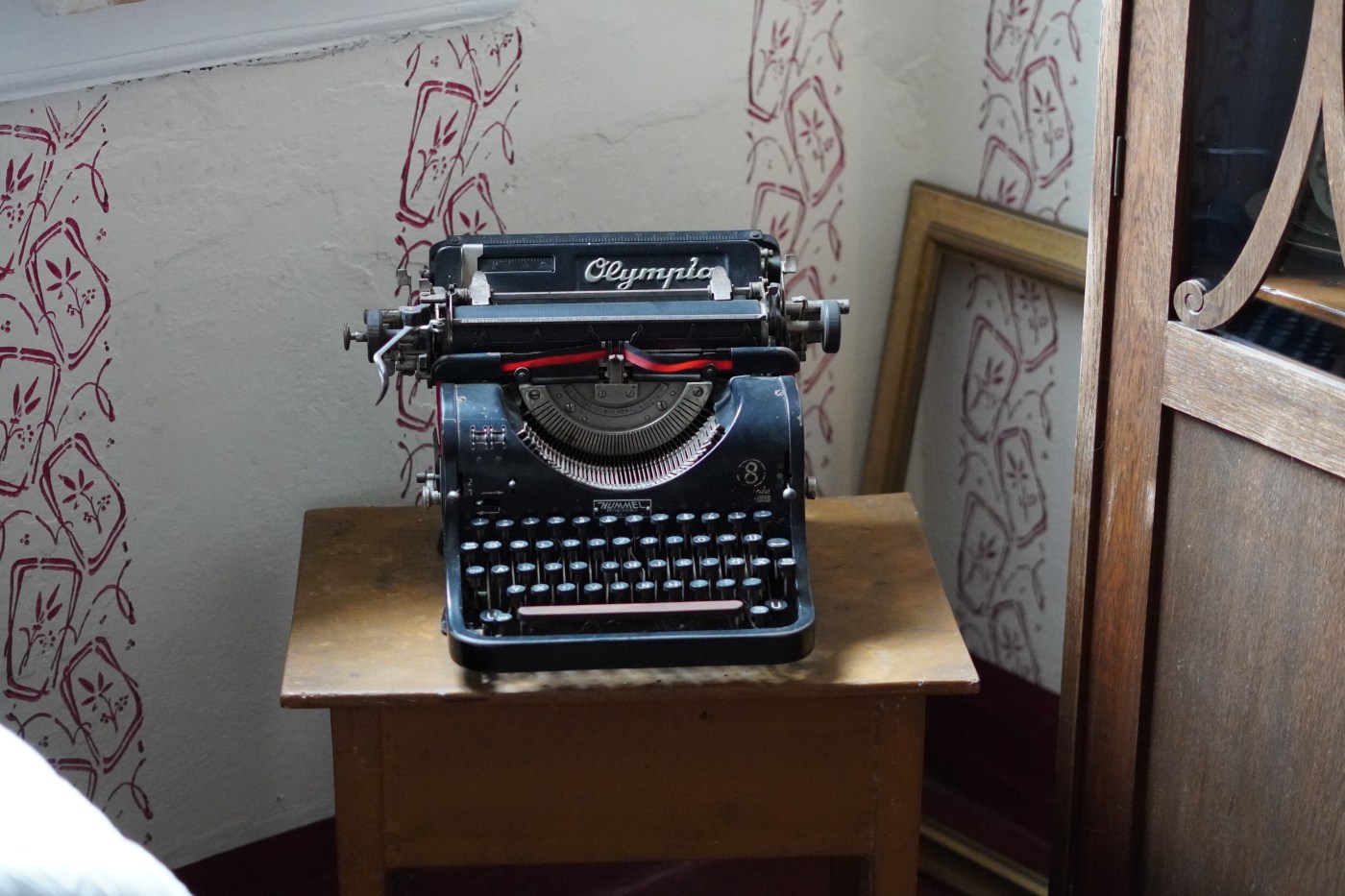
Be humble and keep in mind: Real books were written without the copy-paste-function, probably developed in longhand (so still do I, by the way), and of course by the use of metallic stereotypes. I sometimes wonder if any prolific writer in today’s academia (including myself), with its bulimic publishing habits and debatable quantity standards („publish or perish“), could successfully complete a grounded doctoral thesis on a typewriter. Not to mention the absence of reference management software!
Yes: many writers who could afford it would have an assistant, often a congenial partner, an unmentioned spouse, a non-awarded muse, but there must have been generations of lone writers fighting uphill battles between mind and metallic stereotypes. I imagine them desperately shouting at their typewriters and crumpled paper sheets. How often did I hit my desk, shout out the f-word – and guilty was my keyboard?
I ask myself if the number of typos increased by the time (in my case, they do!), with the technological revolution of the DEL-button, and not to speak of the dumbness propelled by „ai“, as mistakes can be erased easily, if they are given a chance at all? I guess the lack of mistakes and small-scale reflection by doing could be one of the reasons and traps for the ubiquitous stultification.
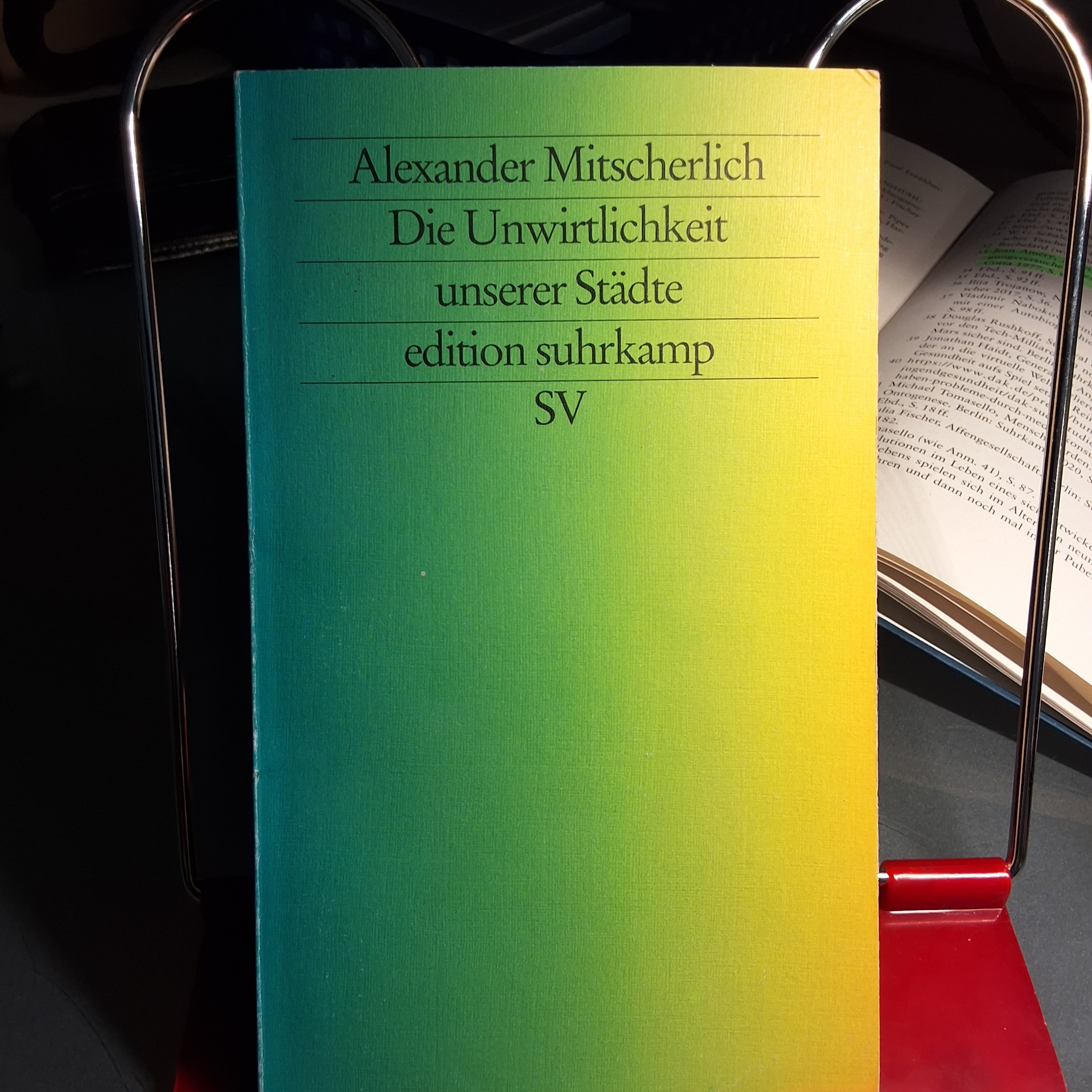
I am amazed by the calm, precise, analytical and, at once, enjoyable and narrative style in which Alexander Mitscherlich wrote his seminal Die Unwirtlichkeit unserer Städte (The Inhospitality of Our Cities). The book is a must read for sociologists, anthropologists, and urbanists or anyone concerned with social space analysis (Sozialraumanalyse). It was first published in 1965, and it predicts much of what would be the return of the (then) newly built large housing estates and city highways in West Germany, following the zeitgeist ideal of the car-friendly city / autogerechte Stadt: every urban biker’s horror, today. The book was undoubtedly written on a typewriter. And then imagine the early Hannah Arendt typing down her Rahel Varnhagen, followed by kilometers and miles of paper sheets, down to the 1970s.
I recently read (Bayerischer Rundfunk, BBC) that physical media and „retro tech“ is a trend in the so-called Gen Z (and I most-often hate the gen-paradigm!). To be honest, I can rarely see people reading real books or magazines in public. I don’t enter a Berlin S-Bahn unarmed by at minimum one „physical“ book, a notebook and a quality-proven, robust pencil (to forget the writing set can ruin my whole day), and I regularly feel like an alien. If the return to books really should be a trend, I support it wholeheartedly. I think it shouldn’t be ridiculed, unless it is „permormative reading“ for social media use. I guess it should rather be seen as a form of resistance of the mind.
References / further reading
Cover picture: A typewriter in the local museum of Friesenhausen, Lower Franconia, Germany (Picture: TS, 2026)
Bowman, R. (2025) Why do Gen Z have a growing appetite for retro tech?, BBC. Verfügbar unter: https://www.bbc.com/news/articles/ckgl8nj8nvzo (Zugegriffen: 15. Januar 2026).
Daher, M. (2026) „Zurück zu Kassette, CD & Co.: Warum ‚Physical Media‘ für die Gen-Z plötzlich wieder zählt“. Verfügbar unter: https://www.br.de/radio/bayern2/sendungen/zuendfunk/physical-media-warum-gen-z-100.html (Zugegriffen: 15. Januar 2026).
Deinet, U. (Hrsg.) (2009) Methodenbuch Sozialraum. Wiesbaden: VS Verlag für Sozialwissenschaften (SpringerLink Bücher). Verfügbar unter: https://doi.org/10.1007/978-3-531-91363-6.
Mitscherlich, A. (1996) Die Unwirtlichkeit unserer Städte: Anstiftung zum Unfrieden. Einmalige Sonderausg. Frankfurt am Main: Suhrkamp (Edition Suhrkamp, 3311).
Reutlinger, C., Haag, C. und Lingg, E. (2011) Raumwissenschaftliche Basics: Eine Einführung für die Soziale Arbeit. Wiesbaden: VS Verlag für Sozialwissenschaften (SpringerLink Bücher). Verfügbar unter: https://doi.org/10.1007/978-3-531-92619-3.
Riese, S. u. a. (2024) Berliner Forum Gewaltprävention Nr. 81 Perspektiven von Bewohnerinnen und Bewohnern und Fachkräften. Berliner Forum Gewaltprävention 81. Berlin: Camino gGmbH / Bezirksamt Neukölln (Abt. Jugend/Jugendamt) / Berliner Landeskommission gegen Gewalt, S. 98. Verfügbar unter: https://www.berlin.de/ba-neukoelln/politik-und-verwaltung/aemter/jugendamt/sozialraumanalysen-1497206.php.
Schad, T. und Riese, S. (2024) Soziale und kulturelle Teilhabe von Kindern und Jugendlichen in der Weißen Siedlung. Sozialraumanalyse im Auftrag des Bezirksamts von Neukölln. Berlin: Camino gGmbH / Bezirksamt Neukölln (Abt. Jugend/Jugendamt), S. 53. Verfügbar unter: https://www.berlin.de/ba-neukoelln/politik-und-verwaltung/aemter/jugendamt/sozialraumanalysen-1497206.php.
 DUNYALOOK
Hinterlasse einen Kommentar