Vorbemerkung: Dieser Blogbeitrag gehört zu einer Serie unter dem Titel und der Leitfrage “Können Netzwerke von Kommunalverwaltungen den Aufstieg des grenzüberschreitenden Neopopulismus herausfordern?” Die komplette Serie ist mein Beitrag zu einem Sammelband von Dr. Agata Rogoś, Postdoc-Stipendiatin an der Humboldt-Universität zu Berlin. Der Arbeitstitel des von Agata herausgegebenen, englischsprachigen Bandes lautet “Permeability of dispossession /... Continue Reading →
[Public Diplomacy] ‚Hemşehrilik‘ (fellow-townsmenship) and the venture of Bosnian-Turkish sibling cities (Part 5/8)
As this example shows, being different from the others -- as Muhacir -- does not mean being other than Turkish: it rather means that there are one or more deep societal conflicts about the understanding how to be Turkish, and/or who determines what Turkish and Turkish culture would possibly be. I was told in practically every single interview with Bosniak Muhacirs (and their offspring) in Turkey what they perceive of as the most fundamental difference between themselves and 'the others': they would never -- down "to the seventh or ninth generation" -- ever marry their akraba (= relatives). Cousin marriage -- in the Arabic speaking Middle East described as bint 'amm marriage by anthropologists -- is in Turkey known as akraba evliliği. It is considered to be an eastern practice by Bosniak Muhacir people in Turkey, which corresponds to the fact that in the Balkans, cousin marriage is practically taboo and considered incestuous. Hence, the reactions of many Bosniak Muhacir people to the fact that some of their Anatolian compatriots practice it, often were expressed in extreme disgust. "Bunlar kültürsüz" -- they have no culture -- was often added as an explanatory comment. The importance of this societal conflict, where representatives of both sides can claim their own establishedness and the other side's outsiderness, should not be underestimated in the way how figurative kinship is established through sibling cities (kardeş şehir), either by representatives of the ruling party, or by Muhacir groups: even though representatives of both groups use the same kinship metaphores (like sibling / kardeş) and speak about culture (kültür), they may fundamentally disagree over the meaning and the role of their agnatic or figurative akraba (kinship) -- as the example of akraba evliliği shows. In the same vein, there are fundamental disagreements over the notion of culture, and the way how culture is brokered by official Turkish cultural centers and initiatives on the market of public opinions in the Balkans.
[Public Diplomacy] The illiberal framework for Turkish municipalities‘ scope of action abroad (Part 4/8)
The long shadow of all these conflicts resonates in the hierarchical interrelationship of Turkey's territorial-administrative structures – and also in the way how relations are established to municipalities in the Balkans. In this regard, one territorial-administrative feature of Turkey is crucial: the institution of the district governorate (kaymakamlık) and/or the governorate (valilik), whose main administrator, the governor, is called kaymakam or vali. The vali is widely regarded as the state’s extended arm into the city – and in fact, it can be seen as a parallel administration to the elected mayors' offices. The vali is directly bound to the centralized government in Ankara, and as such, it can bypass the electoral process, especially the local elections (Mahallî İdareler Genel Seçimleri). In this way, many local governments and municipal leaders who had been elected in the 2019 local elections were, in the meantime, forcibly dismissed and replaced by governors (vali / kaymakam).
[Public Diplomacy] The territorial-administrative structure of Turkey (Part 3/8)
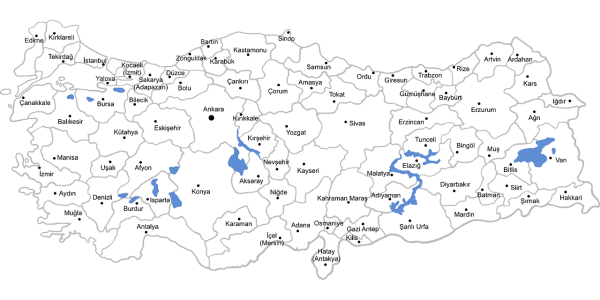
Although the exact number of Istanbulites is subject to discussions, official figures assume that approximately 16 million out of 84.711.239 million inhabitants of Turkey live in Istanbul, which makes up to 20 % of the total population. Together with 29 other Turkish cities (şehir), Istanbul is attributed the status of a metropolis (büyükşehir, literally: big city). As Istanbul comprises 39 districts (ilçe) with their own, respective municipal sub-governments (belediye), each presided by a mayor (belediyebaşkanı), the metropolitan government (büyükşehir belediyesi) of the whole metropolis is represented by the metropolitan mayor (büyükşehir belediyebaşkanı). Currently (January 2021), this position is filled by Ekrem İmamoğlu from the oppositional CHP (as initially mentioned).